
Ukraine's EU Reforms are Bad
While remaining roadblocks to EU membership are serious, Brussels may have a partial solution to expedite Ukraine’s path forward

This article was originally published in the Kyiv Post, it’s free for everyone to enjoy
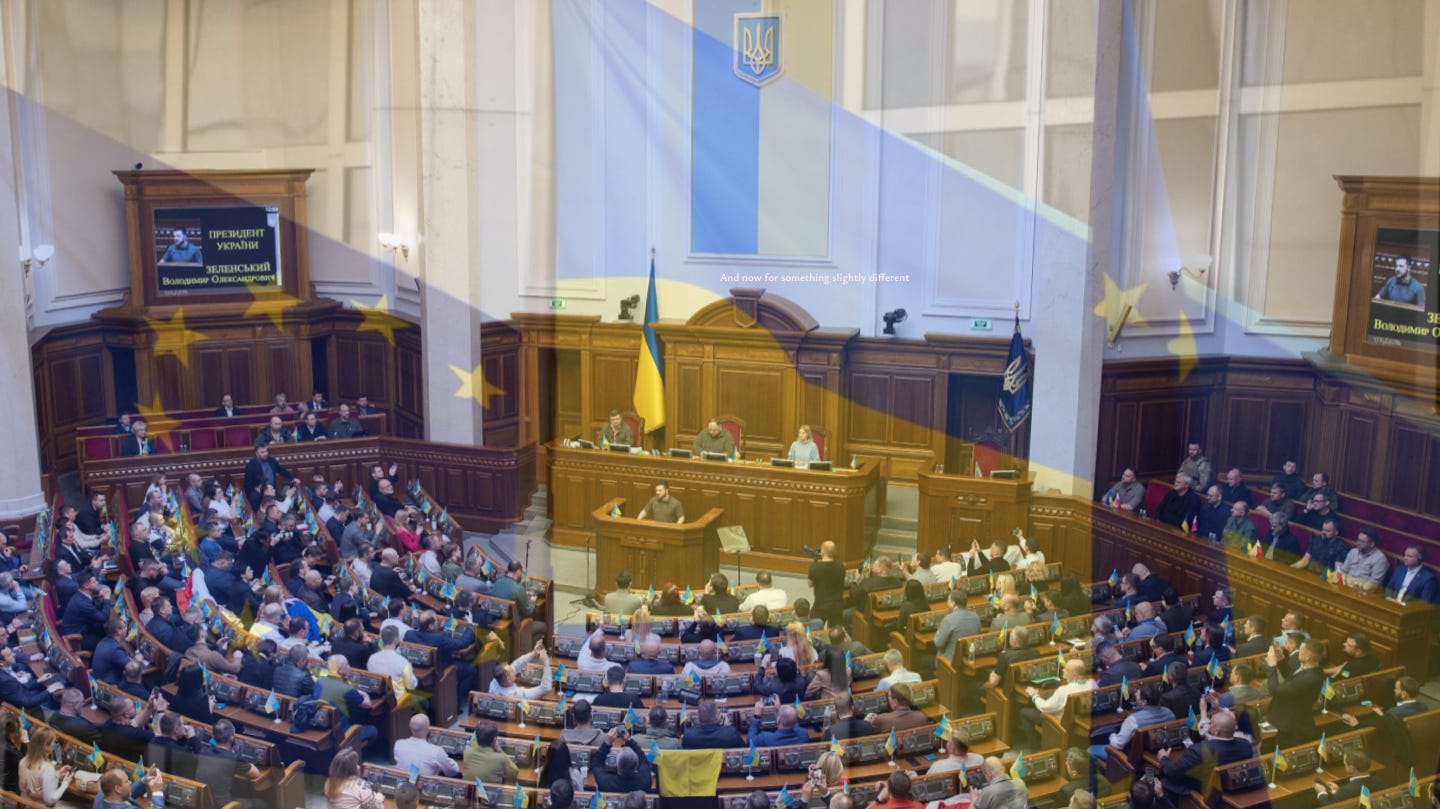
Following the EU decision to grant Ukraine candidate status in 2022 and to greenlight the official opening of accession negotiations in 2024 – despite strong opposition from Hungary – Kyiv’s reform agenda has been mixed, with the Financial Times recently reporting that Paris and Berlin are considering granting Ukraine a “symbolic” membership without immediate voting rights or access to key parts of the bloc’s budget.
To understand Ukraine’s EU accession prospects in full, Kyiv Post spoke to three Brussels-adjacent sources: Mykhailo Zhernakov of the DEJURE (Democracy Justice Reforms) Foundation, Iryna Sushko of Europe Without Barriers (EWB), and a diplomatic source in Brussels directly familiar with the negotiation process.
Judicial reforms under threat
To boost the reforms in Ukraine, described as sluggish, in December 2025, Ukrainian Vice Prime Minister Taras Kachka and EU Enlargement Commissioner Marta Kos condensed the government-approved rule of law roadmap into 10 so-called “Kachka-Kos priorities.” The EU effectively endorsed this front-loading approach.
These priorities include criminal justice amendments, ensuring NABU’s access to independent forensic examinations, involving international experts in the selection process for the High Qualification Commission of Judges (HQCJ), and adopting the Anti-Corruption Strategy and State Anti-Corruption Program, among others.
“This is the bare minimum required to achieve even a basic level of rule of law expected in countries where it is the norm,” Zhernakov told Kyiv Post. His DEJURE Foundation works on advancing judicial reform in Ukraine. “If we fail to do this, we will have no arguments against critics who say Ukraine is corrupt and lacks rule of law.”
However, there is little room for optimism.
“Unfortunately, there has been zero progress on this list over the past three and a half months since Dec. 11, when Ukraine undertook these commitments. These 10 points are meant to be completed within a year – not someday or never,” he said.
He added that key institutions – including the Prosecutor General’s Office, the Supreme Court, the Constitutional Court, and the State Bureau of Investigations – must be brought into a condition where they no longer obstruct reforms but instead support them.
This assessment is supported by an independent report indicating that Ukraine scored just 9 out of 100 overall – and zero in some areas.
Responsibility for progress ultimately lies with Kyiv.
“The situation is often framed as a legislative crisis, but that’s misleading,” Zhernakov said. “The Verkhovna Rada has recently demonstrated its capability to act – 300+ votes on several bills, even constitutional majorities. The issue is not ability, but willingness to make certain critical decisions.”
He points in particular to the need to restore international experts to the HQCJ selection commission.
“The European Union clearly stated in its latest report on Ukraine that this must be done,” he said.
Ukraine has already shown it can mobilize votes when needed.
“Last summer, 311 Deputies voted to restore independence to NABU; the budget passed with 274 votes; and several recent bills received over 300 votes,” Zhernakov noted.
Light at the end of the tunnel
The pessimistic outlook on reforms is somewhat offset by developments in Brussels and EU member states.
One key shift is in Hungary, where Viktor Orbán – long seen as a Kremlin-friendly obstacle to Ukraine – has been replaced by Péter Magyar, a right-wing politician with a more favorable stance toward Kyiv.
According to Kyiv Post’s diplomatic source in Brussels, the EU is still watching Magyar closely. He has already made statements that raised eyebrows, including opposition to the EU migration pact.
Still, he is unlikely to engage in the kind of repeated veto threats and political brinkmanship that characterized his predecessor’s approach.
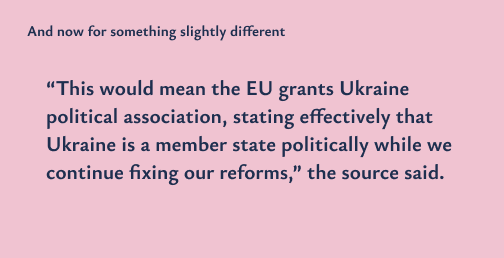
More importantly, there is indeed a scenario under discussion, akin to the one reported by the FT, that could make Ukraine’s 2027 accession goal – previously seen as unrealistic – politically achievable.
Continue reading for free here